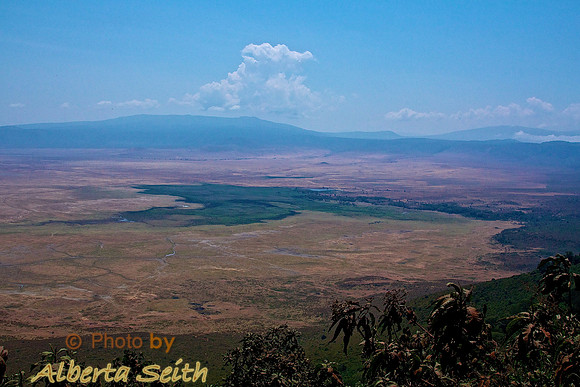
Ngorongoro Crater-Tanzania
The Ngorongora Crater from the rim, 2000 feet above the floor. This is the world's largest unbroken caldera. As a part of the Ngorongoro National Conservation Area, this is a UNESCO World Heritage Site.
Ngorongoro is one of many extinct volcanoes in east Africa’s Crater Highland region. These volcanoes first erupted around 25 million years ago, at a time when the Great Rift Valley, which runs for 4,060 mi from the Zambesi River in the south to Syria in the north, was also being formed. An extensive upheaval in the Earth’s crust was caused when two tectonic plates, began to move apart. In the process of continental drift. East Africa resides on one of the plates, while the remainder of the continent rests on the other. As the two tectonic plates drew apart, a rift opened up in the Earth’s crust, allowing magma, to escape from the Earth’s core.
This molten rock burst through the cones of Ngorongoro and other volcanoes, showering the surrounding plains with lava and dust. After the eruption, a large lake of molten rock is thought to have formed beneath Ngorongoro, close to its surface.
Around 2.5 million years ago, additional disturbances caused this magma lake to drain, leaving Ngorongoro poised above a huge underground cavity. At this time, the volcano’s peak was an estimated 15,000 ft above sea level, a similar height to the present-day Mount Kilimanjaro. The weight of rock, combined with fresh eruptions, caused the volcano to collapse inward, leaving behind an enormous crater – or, more properly, a caldera.